Unearthing the Paper Trails: Lalie Ford, 1870–1924 Census and Records
Roots of the Bayou: Telling the Stories the Water Remembers
Think about the baseline facts of your identity. Your name, your age, the names of your parents, and the number of siblings or children you have. If you had to write them down right now, you would do so without a second thought. They are the fixed anchors of your life.
But imagine a stranger walking up your driveway over a century ago. He is hot, exhausted from the heavy Louisiana humidity, and carrying a massive leather-bound ledger. He is the federal census taker. As you speak, he listens through the filter of a thick regional accent, dips his quill in ink, and begins to write.
With one careless slip of his pen, your identity is completely rewritten. You suddenly age backward. Your mother’s name is scrambled. Your real siblings vanish from the record entirely, replaced by names you don’t recognize.
This isn't a thought experiment; it is the fragile reality of historical genealogy. When we look back at the archives of the deep South, we quickly find that history doesn't always tell the truth—sometimes, it leaves behind a funhouse mirror.
Today, we are diving deep into the mud and the microfilm of St. Landry and Evangeline Parishes to piece together the remarkable, shape-shifting paper trail of Eula Lee Lalie Freeman. Her life was sprawling, vibrant, and filled with thirteen children—but if you only looked at the surface of the official records, you might believe she was a ghost.
The Real Lalie and the Flawless 1870 Census
To understand how easily a life can be distorted by history, we have to start where the ink was pure. Eula Lee Lalie Freeman (often recorded simply as Lalie or Eulalie) was born in Louisiana around May of 1860. She was the daughter of Henry Ford Freeman and Eloise Valerian.
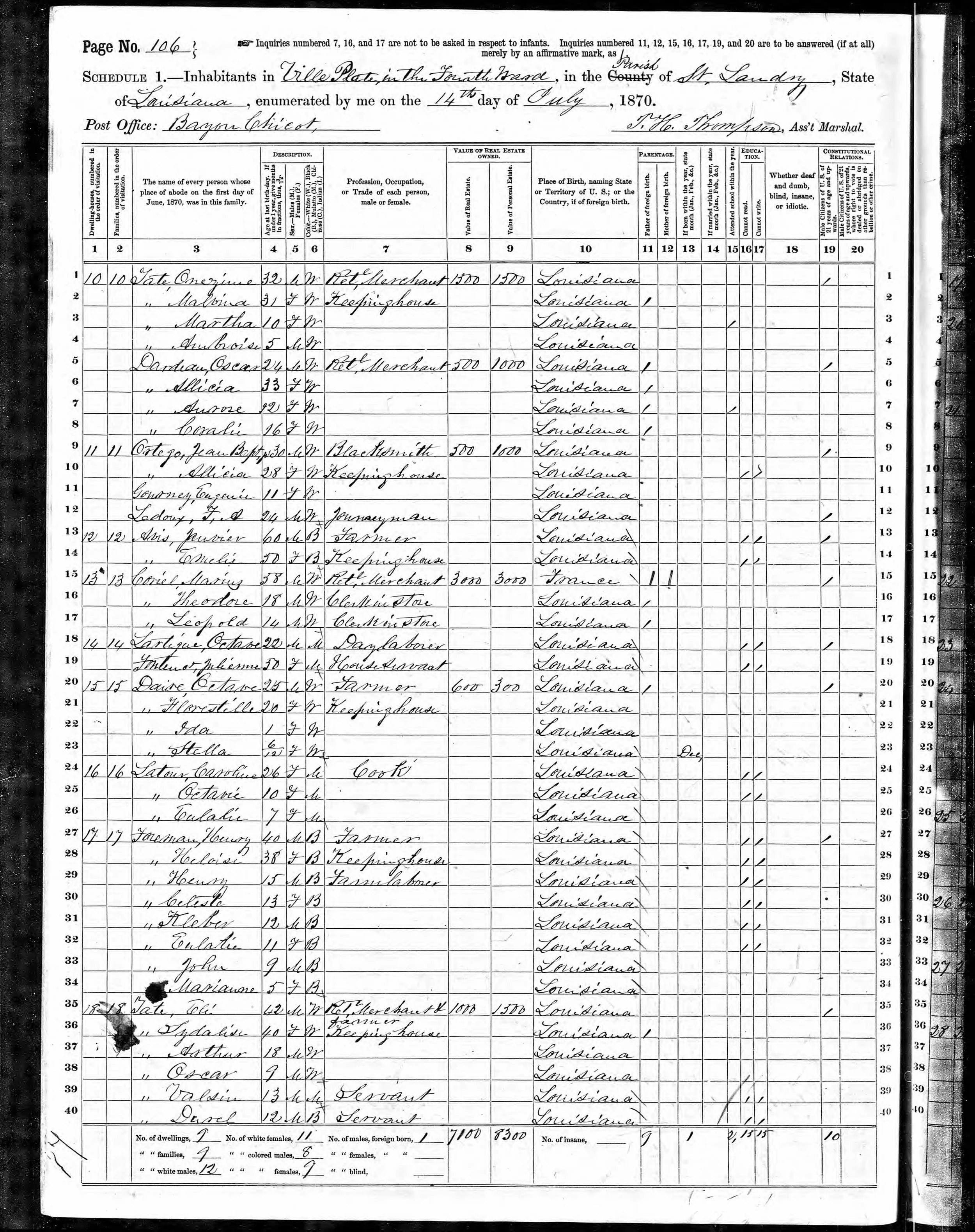
The very first time Lalie steps onto the stage of the historical record is in the 1870 Federal Census.
America was just five years out of the Civil War, and the reconstruction of the South was underway. The enumerator who walked through Ville Platte, within the 4th Ward of St. Landry Parish, did his job beautifully. He captured an accurate, pristine snapshot of an early childhood.
The document records 11-year-old "Eulalie" living with her 40-year-old father, Henry, and her 38-year-old mother, "Heloise." This lines up mathematically with her 1860 birth year. Beside her in the household are her true siblings: Henry, Celestine, Heber, John, and Marianne.
It is a genealogist’s dream. It is clean, it makes sense, and it grounds her reality. But just ten years later, the paperwork would descend into complete chaos.
The Great Census Mess of 1880
If you have ever dug into your own family roots, you know that some census takers were meticulous historians. Others probably shouldn't have been handed a bottle of ink.
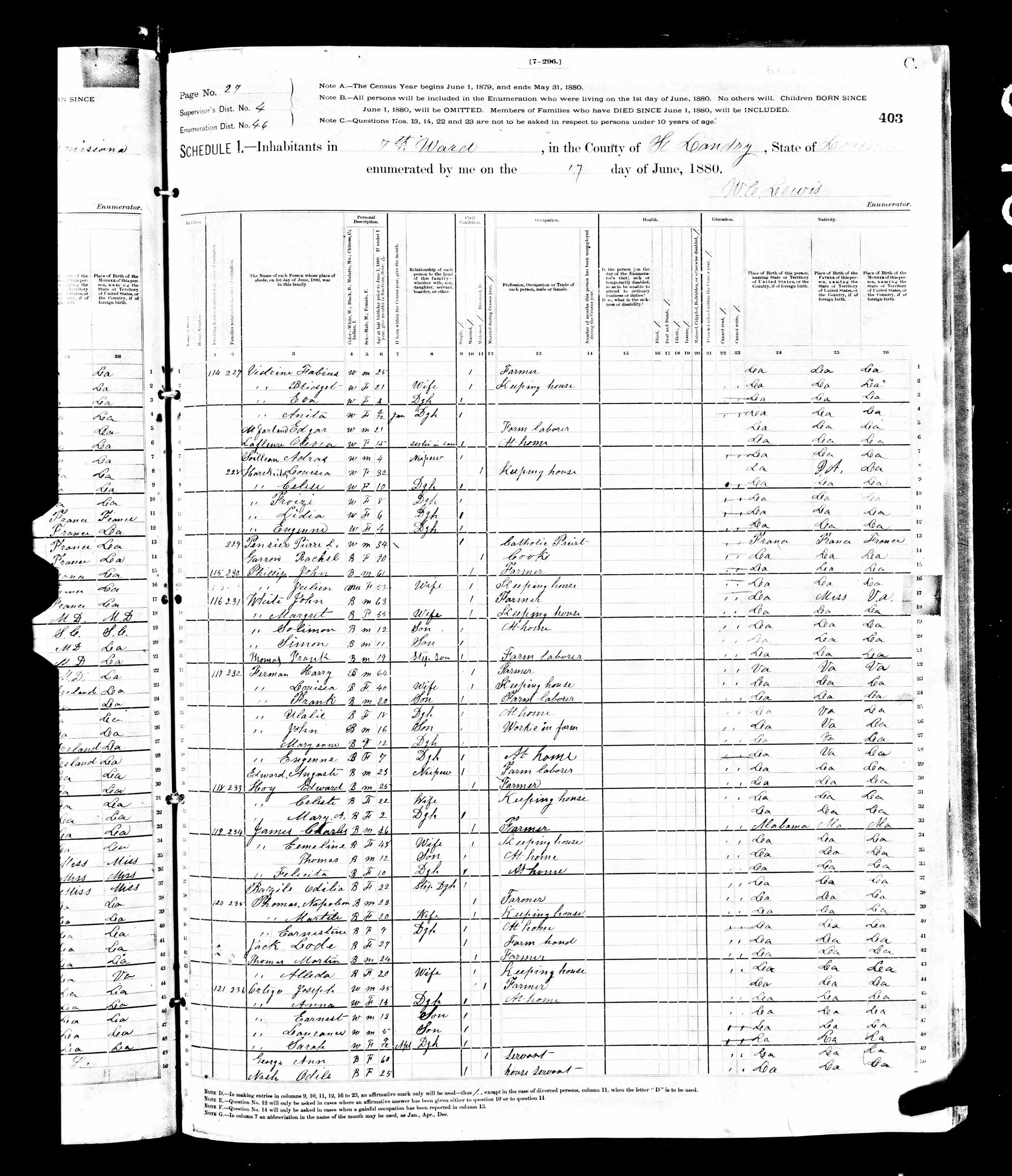
By the time the 1880 Federal Census rolled around, Lalie was a young woman of about twenty years old. But if you were to rely solely on the document filled out by the enumerator for the 5th Ward of St. Landry Parish, you would think she was living a completely different life.
The record is a masterclass in bureaucratic error:
The Name & Age Disaster: The census taker misspelled the family surname entirely, writing "Ferman" instead of "Freeman." Then came the math. Despite being recorded as 11 years old a full decade prior, "Ulalie" was listed as being just 12 years old. In ten years, she had somehow aged only a single year.
The Parent & Sibling Scramble: Her parents’ names were butchered into "Harmen" (likely a mishearing of Harry or Henry) and "Louisia" (Eloise). More bafflingly, the census taker dropped her actual siblings from the record and listed a completely different set of children in the house: Joseph, John C., Agalia, Victoria, Amelius, and Adolph.
To a casual researcher, this looks like a completely different family. But by tracking the geography, the phonetics of the names, and the surrounding neighbors, we realize the truth: this is the exact same Lalie. The enumerator simply had a terrible, careless day at work.
Two Marriages and the Power of Maternal Math
Thankfully, Lalie’s real life didn't stall inside the errors of that 1880 ledger. Just one year later, her true journey as a wife and a mother began, unfolding across two marriages and a staggering legacy of thirteen children.
First Marriage (1881)
On December 17, 1881—just a year after the census taker labeled her a twelve-year-old child—a twenty-one-year-old Lalie married her first husband, Jean Baptiste Acliss. Their union was brief but meaningful; they brought two children into the world, including a son named Jean Baptiste Acliss Jr., who would grow up to marry in 1912.
Second Marriage (1884)
By 1884, Lalie remarried, this time to a man named Jean Baptiste Lafleur. Together, they built a massive, bustling life in rural Louisiana, welcoming eleven children into their home.
When you combine her two marriages, Lalie gave birth to a total of thirteen children.
If the 1880 census was history's mistake, the subsequent records were its apology. When we look at the 1900 Federal Census, we find a 40-year-old "Lalie" living in the 8th Ward of St. Landry Parish with Jean Baptiste Lafleur. The document notes they have been married for 16 years, aligning perfectly with their 1884 wedding. Crucially, the "mother of how many children" column notes she has given birth to 10 children, with 9 still living. The house is overflowing with life: Mary, Jules, Oscar, Tommy, J.B. (Jr.), Kossuth, Georgina, and another son named Jean Bt.
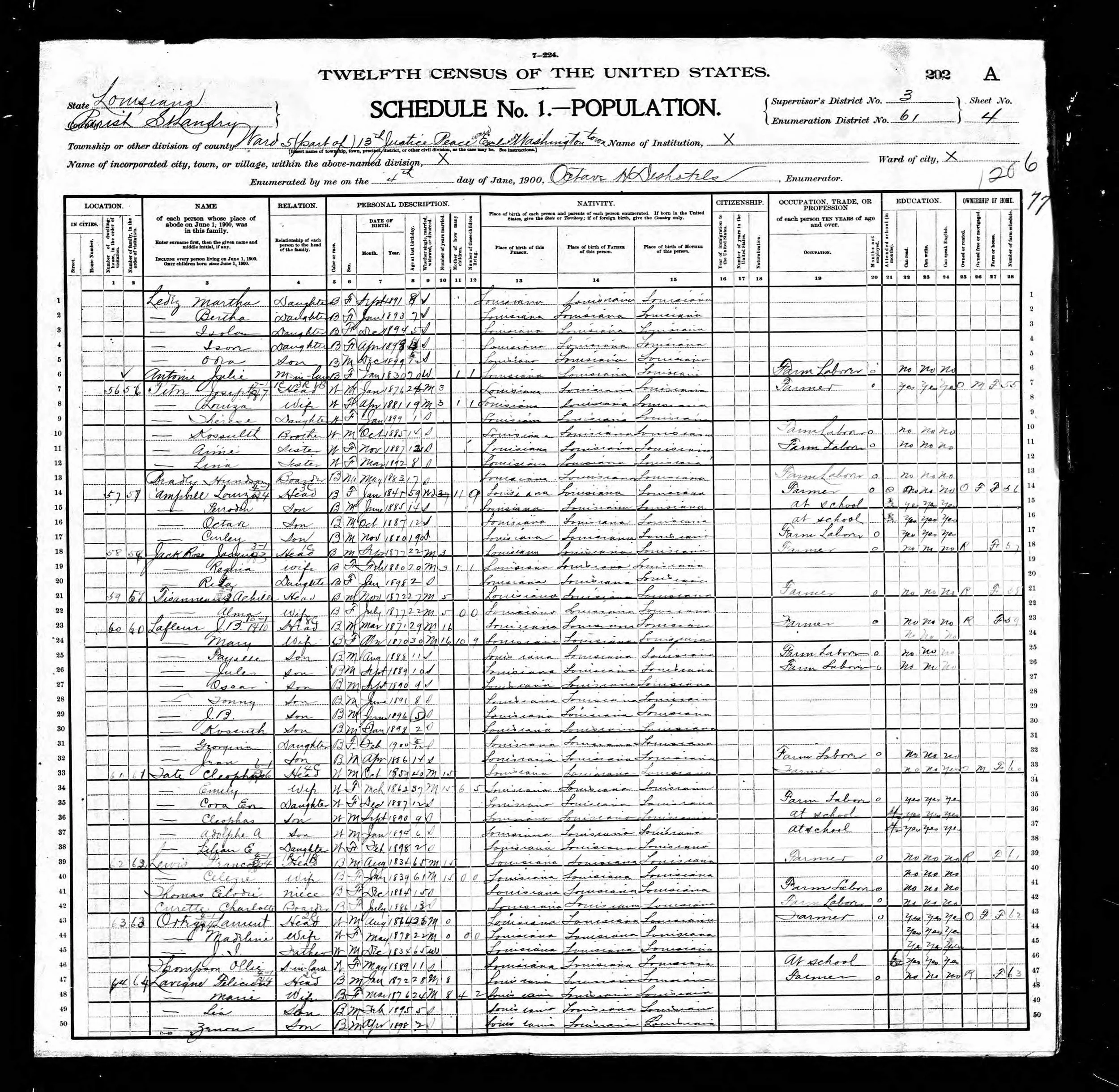
1900 Census Louisiana St. Landry Parish 5th Ward, town. of Washington
By the 1910 Federal Census, the family is living in the 5th Ward of the newly carved Evangeline Parish. Lalie is now 50, recorded as married for 26 years. Here, the maternal data column captures her entire life’s legacy: it states she has given birth to 13 children total, with 11 still living. The math is flawless. Two children from her first marriage, plus eleven from her second. Two plus eleven equals thirteen. The 1910 census acts as a perfect mathematical bridge, validating her entire reproductive history in a couple of ink strokes.
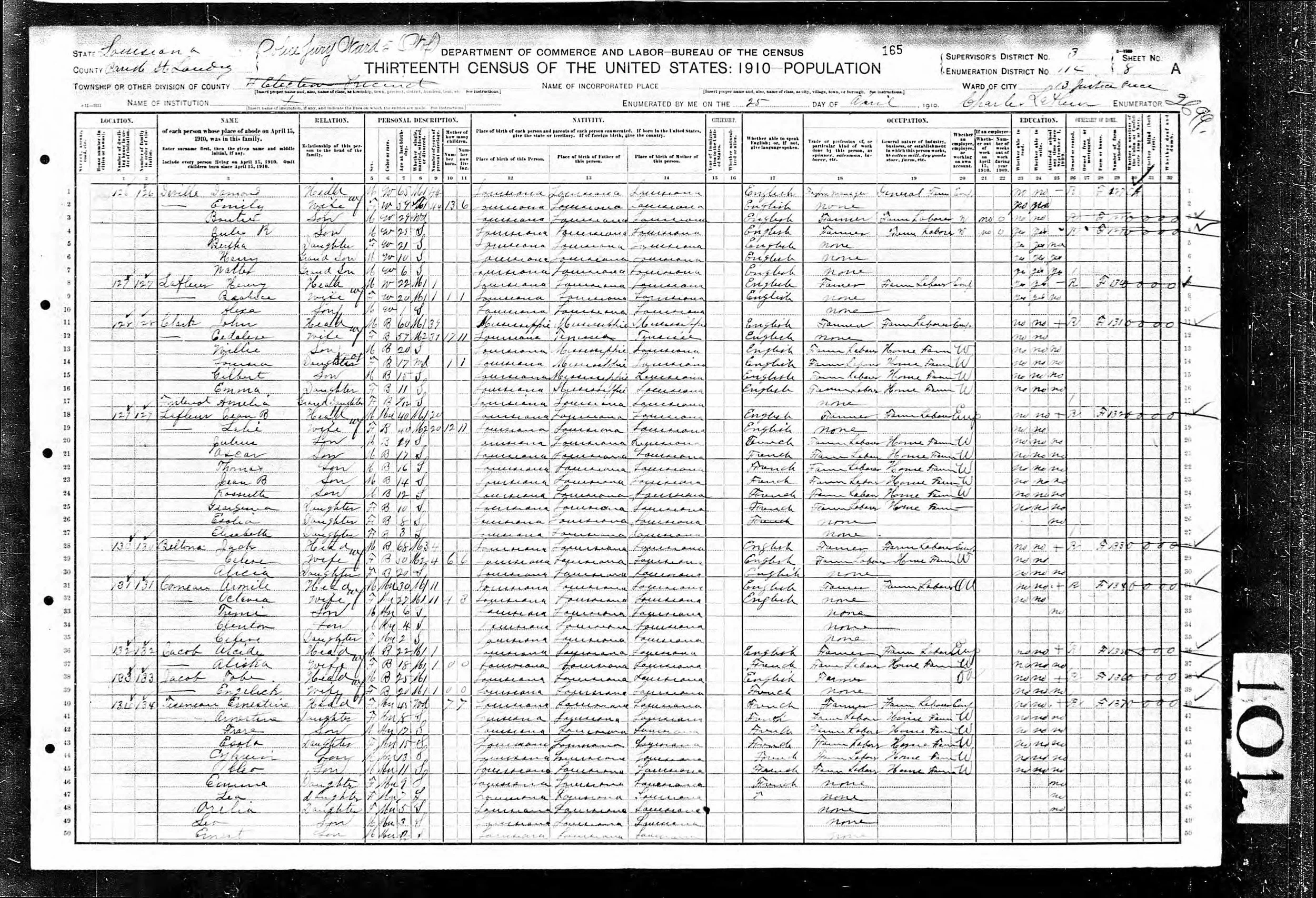
1900 Census Louisiana St. Landry Parish 5th Ward,
The Case of the Faint Ink and the Hidden "Yes"
As researchers look past 1910, a mystery emerges: When did Lalie die? Because local death registrations in early 20th-century Louisiana were often inconsistent or lost to time, we do not possess an official death certificate for Lalie. For years, some researchers assumed she passed away prior to 1920 because her name seemed to disappear, or because later forms looked blank.
To find the truth, we have to look at the documents left behind by her children: their marriage licenses.
In Louisiana during the 1910s, marriage applications included a questionnaire at the bottom of the page. It asked for the name of the mother, followed by a specific checkbox: "Living: Yes or No?"
When we put Lalie’s children's marriage records under magnification, a clear timeline emerges, shattering the theory of an early death:
Jean Baptiste Acliss Jr. (November 1912): Lists his mother as "Eulalie Ford" (using her father's middle name, a common family variant). Living status: Yes.
Oscar Lafleur (December 1912): Lists his mother as "Lalie Ford." Living status: Yes.
Gilbert Lafleur (December 1912): Lists his mother as "Lalie Ford." The handwriting is faint, messy, and easily misread as blank, but context clues and her husband's active status confirm the household is intact.
Tomy Lafleur (August 1917): Lists his mother as "Lalie Ford." Living status: Yes.
Jean Baptiste Lafleur Jr. (December 1917): Lists his mother as "Lalie Lafleur." Living status: Yes.
Georgina Lafleur (December 1917): Lists her mother as "Lalie Lafleur." Living status: Yes.
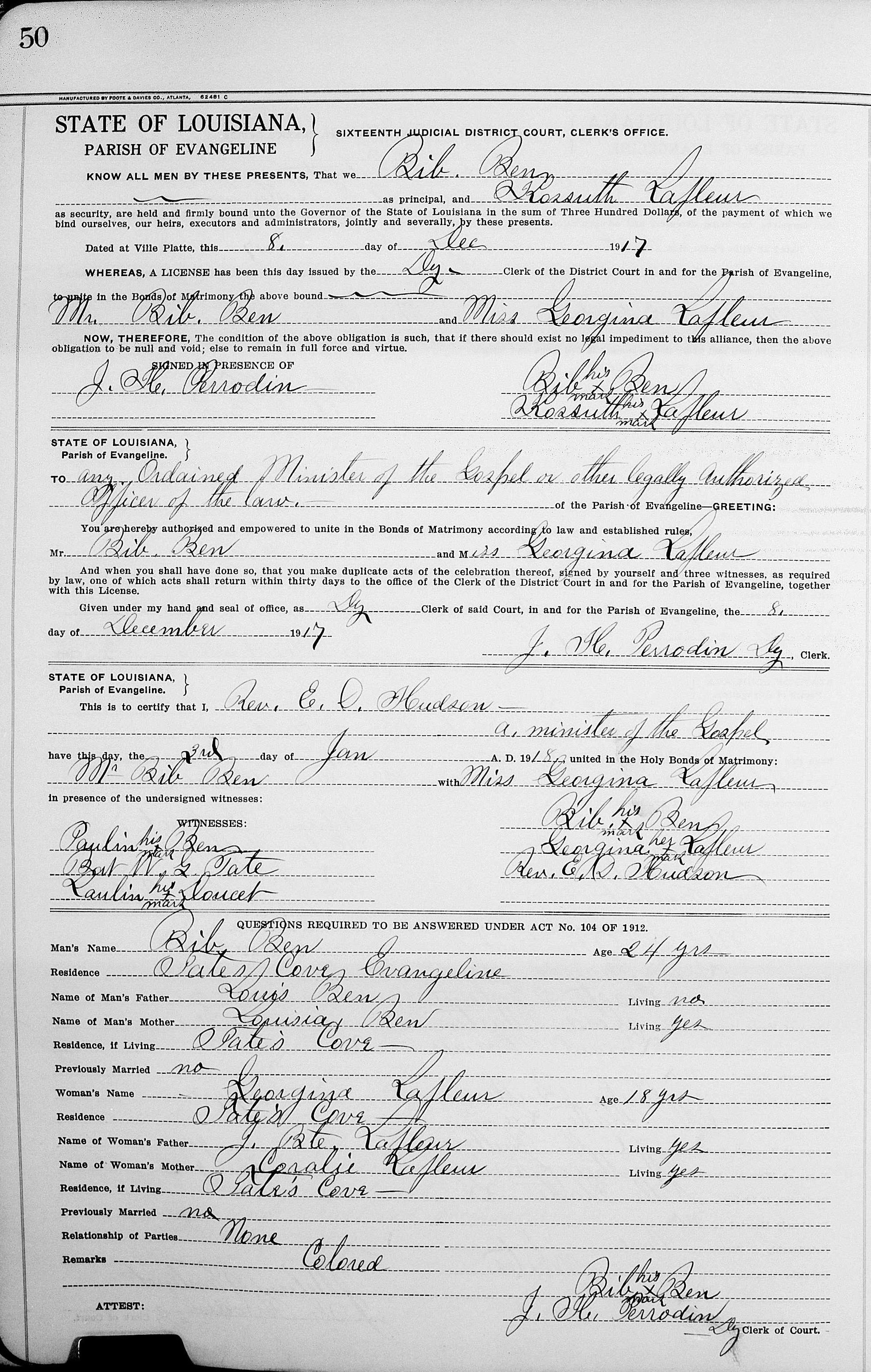
Georgina Lafleur and Bib Ben, marriage license December 8, 1917
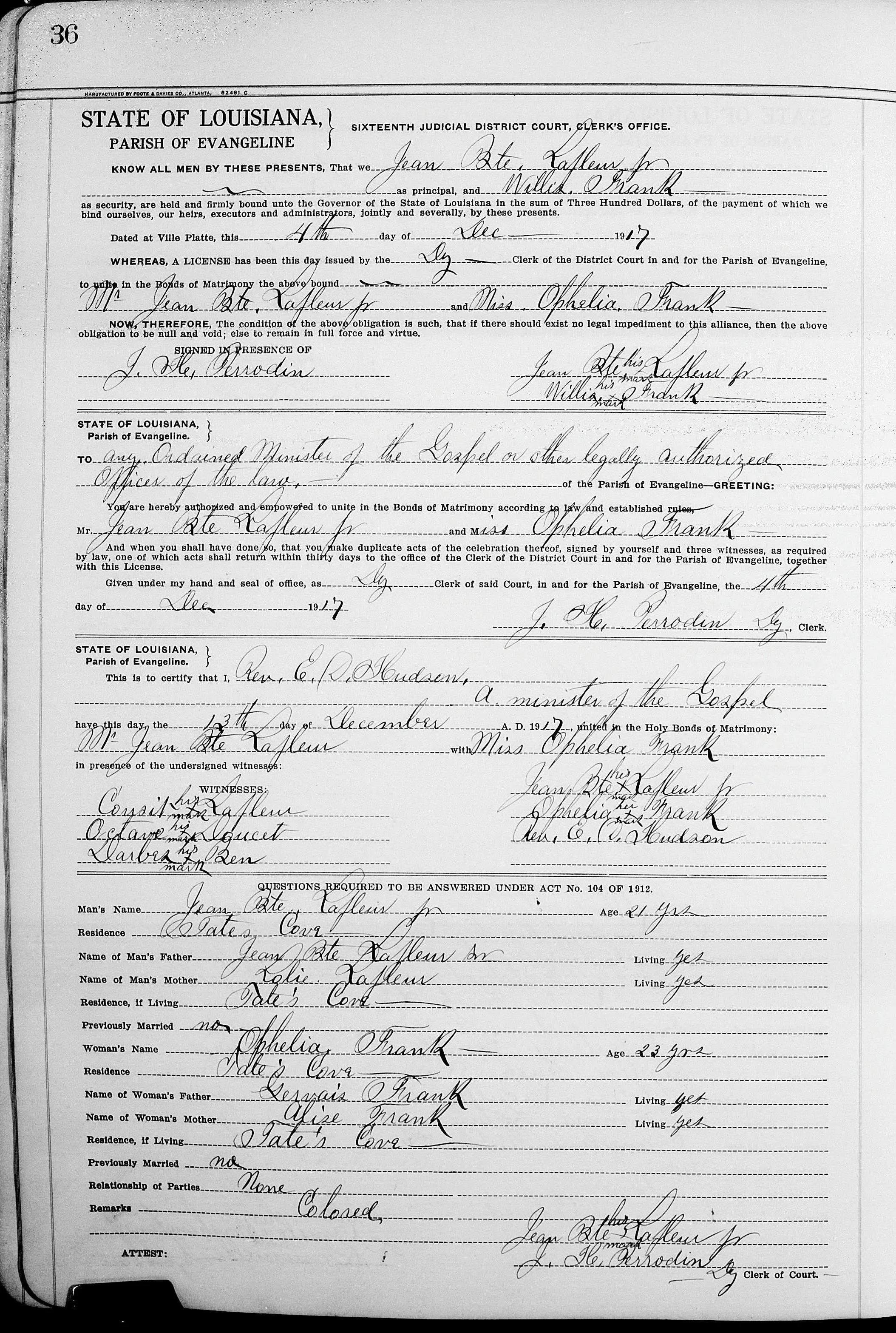
Jean Baptiste Lafleur Jr and Ophelia Frank, married on December 4, 1917
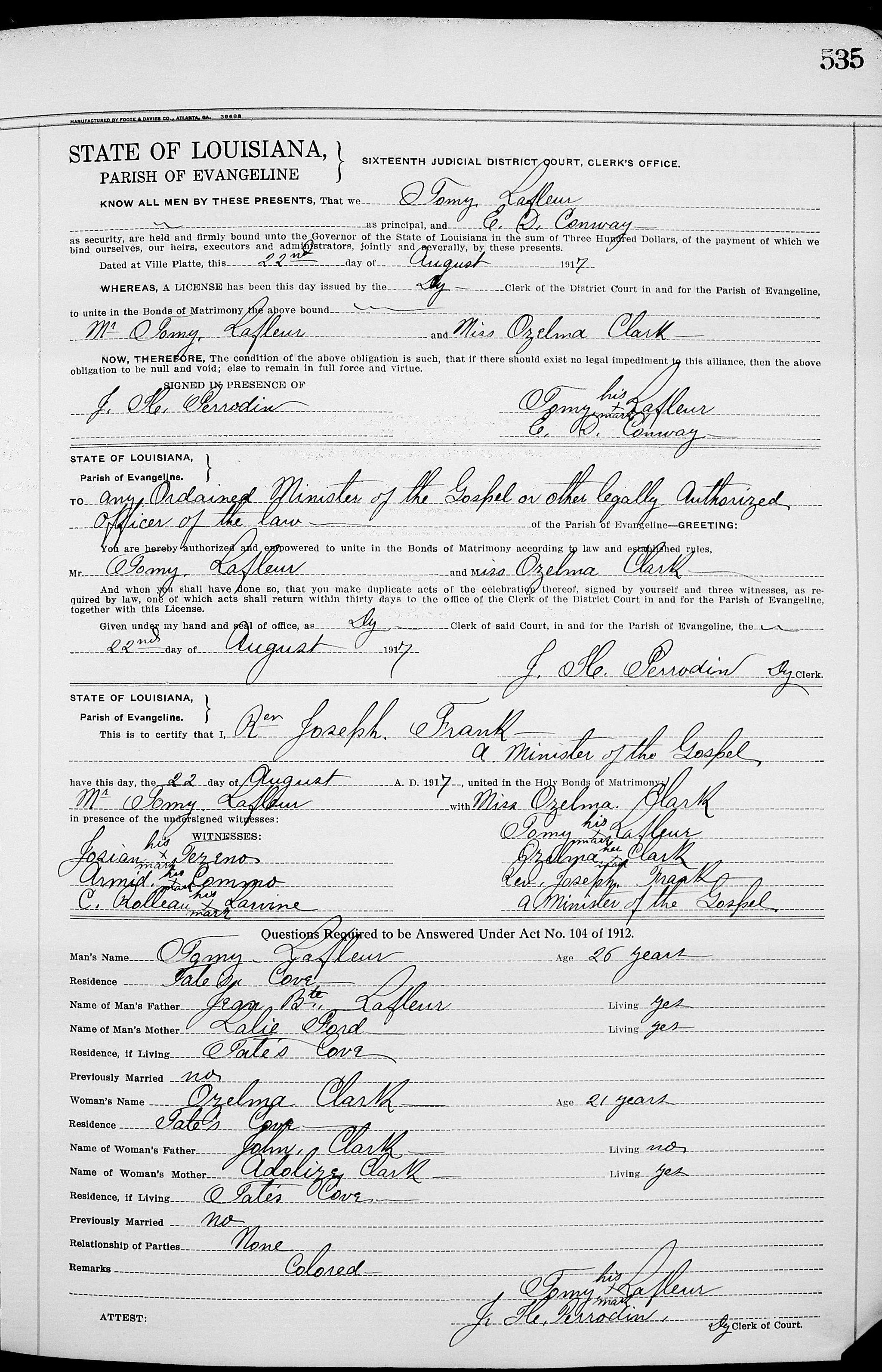
Tomy Lafleur and Ozelma Clark, married August 22, 1917
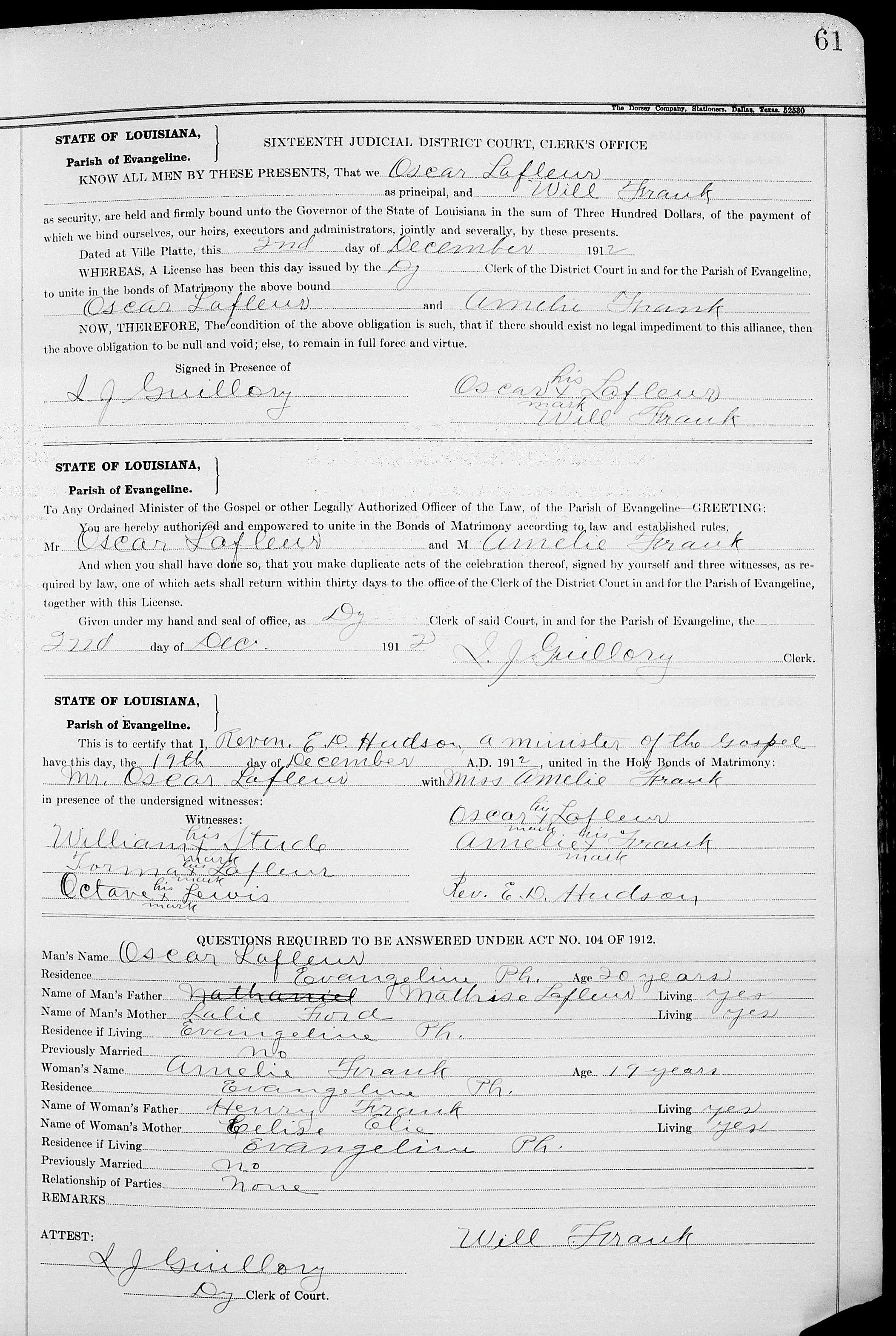
Oscar Lafleur and Amelia Frank, married December 2, 1912
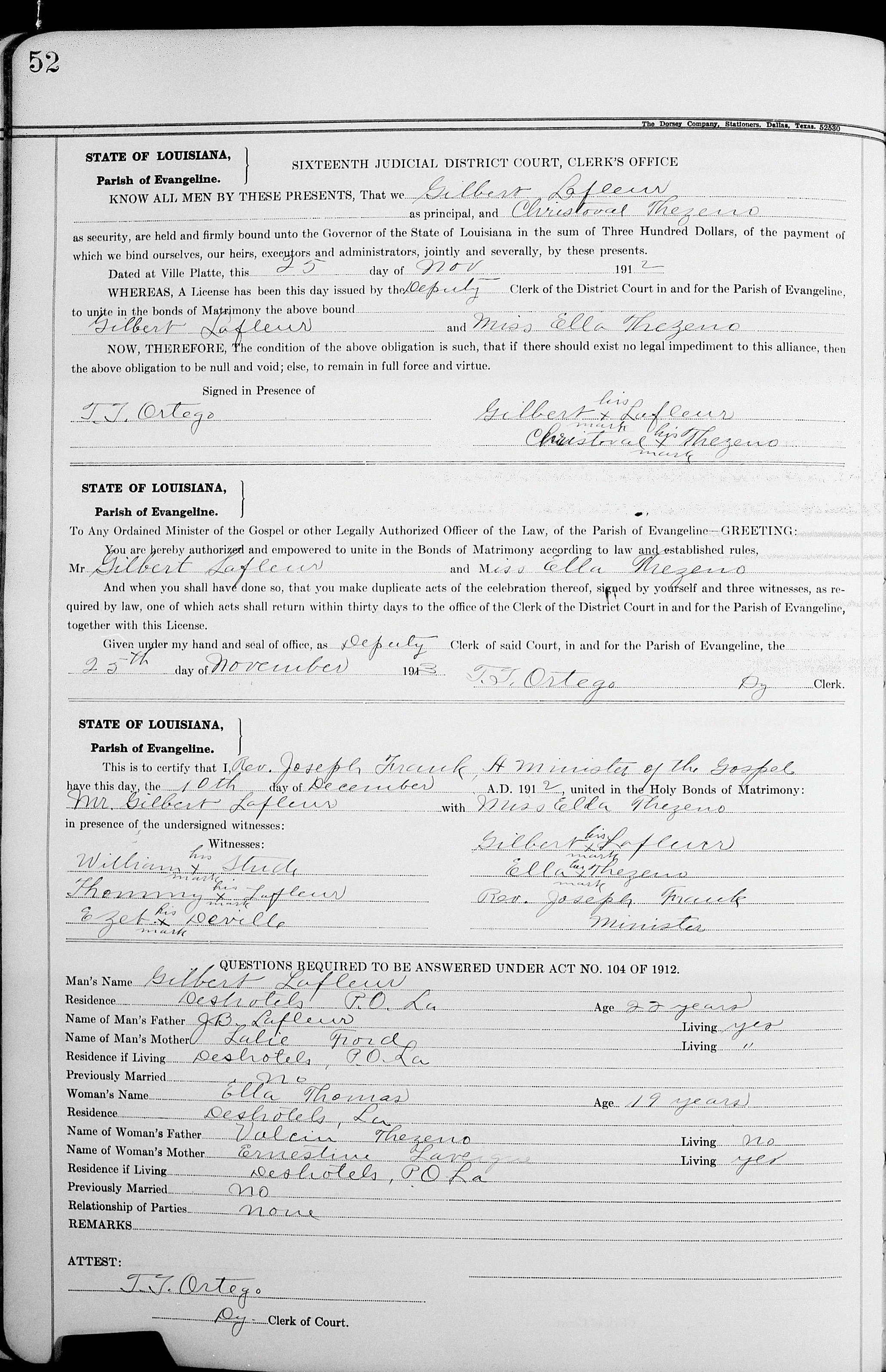
Gilbert/Jules Lafleur and Ella Thezeno, married November 25, 1912
The Optical Illusion of the Ledger
If the paperwork explicitly says "Yes" at the end of 1917, why did earlier researchers think she was already gone?
The answer lies in an optical illusion common to old microfilm and digital scans. In those days, large parish register books recorded two separate marriages per page—a left half and a right half.
If you examine Georgina Lafleur’s December 1917 marriage license on the left side of the page, and your eyes accidentally drift to the unrelated wedding on the right side (for a couple named Otis Strother and Irene Campbell), you will see that the bride's mother there is marked "Living: no." It is incredibly easy to glance across a tight ledger line late at night and mistakenly attribute that "No" to the wrong family. One tired look, and history accidentally erases Lalie three years too soon.
Act V: Telling the Stories the Water Remembers
Because those late-1917 marriage licenses explicitly mark her as alive, we know with total certainty that Lalie survived to see the cusp of the 1920s. She watched her sons register for the World War I draft, and she endured the heartbreak of November 18, 1919, when her son, Jean Baptiste Lafleur Jr., tragically died of pulmonary tuberculosis while serving in the military.
But we can push her timeline even further, past 1924, using one final, somber document.
In March of 1924, Lalie’s husband of forty years, Jean Baptiste Lafleur, tragically drowned. When the informant provided the data for his official death certificate, they had to declare his marital status. The box was marked "Married"—not "Widowed."
Assuming the informant knew the family dynamic, this tells us that when Jean Baptiste drew his last breath in the waters of Louisiana, Lalie was still alive. She passed away sometime after the spring of 1924, leaving behind an enormous lineage. Those 11 surviving children went on to populate the 20th century; her son Tomy, for example, is found living a long life in the 1940 federal census.
Conclusion: The Truth Left in the Ink
Lalie Freeman never wrote a book, ran for office, or trended on a digital feed. She was a woman of the Louisiana soil who quietly anchored a massive family through decades of monumental American history.
Her story reminds us that the documents left behind in archives are deeply human artifacts. They are prone to exhaustion, bad handwriting, mishearings, and page alignment errors. But if we are patient enough to look past the funhouse mirror of records like the 1880 census, and if we cross-reference the math of a mother's love, the truth eventually rises to the surface.
Lalie wasn't a ghost. She was a mother, a survivor, and a baseline truth of the bayou. And the ink always leaves a trace for those willing to look.
Want to listen to the full audio journey of Lalie's life? Check out Episode 2 of the Roots of the Bayou Podcast. Unlock our entire archive of hidden Southern history, exclusive deep dives, and bonus episodes by grabbing your $15 All-Access Pass at RootsoftheBayou.com.